PayPal being one of the most widely used payment gateway in the world is usually picked by merchants to accept payment from customers.
Here’s a quick guide on how to add PayPal to InstanteStore and how to link your store to PayPal.
PayPal being one of the most widely used payment gateway in the world is usually picked by merchants to accept payment from customers.
Here’s a quick guide on how to add PayPal to InstanteStore and how to link your store to PayPal.

Find out how the Instantestore Point of Sales System can help you save time and generate sales!
The InstanteStore team just launched another 3 NEW responsive and mobile friendly templates (yay!) (more…)

When I say transactional communication, the first thing that pops out is email. And why shouldn’t it? More than 90% of businesses use email as their defacto channel of communication. Be it sending shipping alerts, order status or just newsletters – Email works just fine. Though, what is unusual is that even heavily engaged mobile app users get emails.
Doesn’t sound like the best of the experiences.
Email is important and I am not trying to kill it here but not every single detail needs to be sent via Email. Product Managers are increasingly exploring better methods of communication. The underlying communication principle remains the same. As McKinsey consultants say:
MECE – Mutually Exclusive. Collectively Exhaustive.
Simply put, transactional communication takes place between a seller and a consumer. It occurs in commercial websites that offer users an opportunity to buy. The messages trigger to the targeted audience, who have taken an interest in a product or service and purchased it.
Now that technology is leaving footprints everywhere, one can book cabs, order food and groceries in just a couple of clicks. But without proper communication, it all falls apart. It’s annoying to make multiple calls or keep visiting a website just to know where you cab is or by when your food will be delivered. Constant real time status updates play an important role in these kind of situations.
Imagine your tummy is grumbling, and you are not sure when the food is going to arrive at your doorsteps. So you wonder if you should get a small snack to calm your stomach, or if you should keep waiting for the order to arrive. Updates like ‘Your food is being prepared, will be ready in a jiffy’ followed with ‘Your order is ready and out for delivery within 15 mins’, gives you assurance that food is on the way.
Post transaction communication is critical for any business. Users demand instant gratification and want to know everything about their purchase & shipment. Businesses today not only track, but also share every single piece of information about the transaction with the user.
For instance, Amazon offers the option to get updates every time their shipment moves. Result – users get dozens of notifications about where their order is, and when they can expect delivery.
Here are some basic check points for product managers to tick as they decided what channel to use for communication (related to transactions)
But, again, lot of users find sharing mobile numbers intrusive. App Push Notifications and web notifications come in handy for such scenarios. They help you communicate easily with the user (device) without being intrusive.
Show of hands: people who have had overwhelming anxiety while performing an online transaction. I am pretty sure half the people reading this have their hands held up high. Even though the digital age was embraced with open arms, users have always had panic attacks while buying things online.
In the beginning, people were hesitant and frightened to buy anything digitally. But now, users have evolved along with the whole online concept. Despite that, one skips a beat when one has no idea what is going on with the transaction.
It happens more than often that your internet dies or your screen just freezes mid payment. You don’t know if the payment has been made, if the order is placed or if you have to go through the procedures all over again. Who tells you that? Waiting for seconds seem life eternity in situations like these. Some sort of communication is necessary to avoid frustrated customers.
A clear mode of communication is necessary for effective communication. Lack of proper communication creates perplexed and unsatisfied customers.
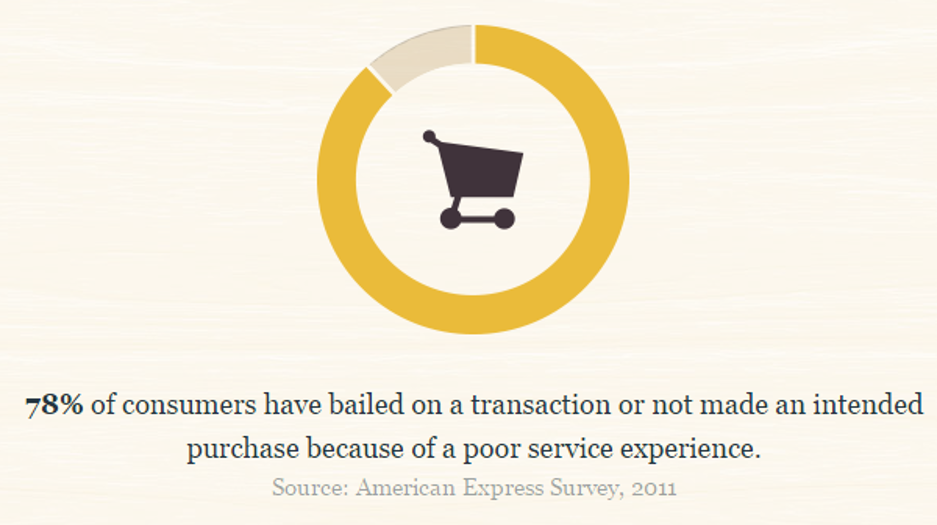
Transactional communication comes in handy in numerous situation. Let’s say you have to buy new sunglasses, so you spend some time choosing the best (considering that you are choosy). Then you proceed with the payment. You are almost on your feet jumping for joy, but the ‘payment successful’ page doesn’t appear. You fall into a dilemma, wondering if your payment went through.
There are scenarios when you need to order something, and just finished the transaction. The payment has been deducted from your account, but it has not redirected to the main page and the error page appears.
Due to an absence of communication (or misleading communication) announcing if the order has been placed or not, you buy it again, ending up with double transactions sometimes. Though the money is refunded in a few days, the situation is disturbing.
Now that you agree that a mode of communication is necessary to keep things intact (yes, even your heart), let’s see which transaction communication channel you should be looking at.
Email and SMS is what most product managers depend on while communicating with end users. While these channels have existed for a while-given the options we have-the current user experience is limiting. Though they have their own set of advantages and disadvantages, let’s evaluate how the SMS, Web Push, Email and App push notifications fair on the identified metrics and how best the user experience can be improved.
Delivery reports are essential for you to know that users receive the information. Transactional communication plays a critical role for the consumer. Hence the delivery report is necessary to run things smoothly. Click through Rate (CTR) shows if the user has interacted with your message.
SMS – In SMS, one can check if the message has reached the users. The delivery report assures that the information reaches the user. As far as CTR’s are concerned, it is a cumbersome process to check whether the user has opened the message and if the they clicked a CTA.
Web Push – One can check the delivery report and the CTRs with ease by checking out the dashboard to see if the user clicked the messages. The open rates can also be tracked.
Email – It is possible to know if the email has landed in the inbox. There are many extensions out in the market (free ones too), to check if users have opened your mail or in other words, you can know who has read your email.
App Push Notification – App push stands with a 6 – 15% CTR. As for delivery reports, the apps need to turn to another software. Its double the effort to find out if your notification is delivered. So, you can’t be sure if the user really received your information.

Some information needs to be accessed even after you are done with your payment. Let’s say you have made a purchase and your order details are sent to you. In that moment it might not make sense to track your order delivery, but you will need to in a few days. Here is where you need a medium with good shelf life, so that you can refer to it when the situation demands.
SMS – With amazing shelf life capability, SMS makes it easier for users to go back and check the details of the purchase. If some problem occurs you can always refer to the order number and place a complaint.
Web push – As web push is a quick way to inform users, it projects the needed information, and stays till you dismiss it. Let’s get this straight, it is not feasible to store web push notifications for future access.
Email – The inbox stores emails and stays there till the user deletes it. One can find the email that you had sent, by just searching your company’s name. The only problem here is, you might have sent it to the user, but what if your email lands in their junk mail?
App Push Notification – The notification prompts the user and gets stacked in the notification tray. App push is best to keep users informed about every minute detail about the transaction. If the user mistakenly dismisses everything in the notification tray, your information goes for a toss.
A user should have a good experience shopping with you, so that they would opt you again. Cramming their phones with numerous updates makes it exasperating for the users.
SMS – SMS lands direct to your inbox and stays there until the user deletes it. Filling their inbox is not a good thing. It so happens that sometimes new messages do not get delivered due to insufficient space on the phone.
Web Push – Web push doesn’t take any space of the user’s phone. It updates and just stays in the notification tray (until dismissed). Hence, providing more breathing space.
Email – Once the inbox is full, it would stop accepting new emails. Here the feud between your email and space arises. But if the user has sufficient space in the inbox (might be risky to assume), every new email sent by you as a continuation to the previous mail does not cram the inbox and confuse the user.
App Push Notification – Just like web push, it doesn’t consume any space. It can be dismissed easily. It gives a crisp information. One doesn’t have to read a large amount of text, just to get order confirmation.
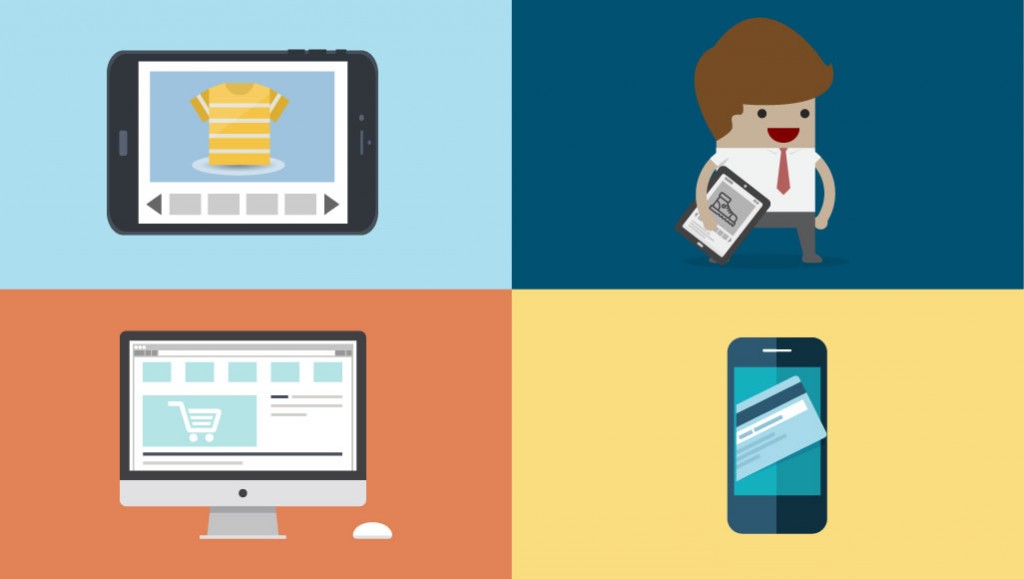
Imagine you are buying something on your laptop. You cant keep checking your phone just to get updates. For example, you have kept your phone for charge, and are making a purchase on your desktop. You need to go all the way to the phone to check if you have any transaction messages. This becomes inconvenient after a while.
SMS – It is typically a mobile centric channel. One needs to be on the mobile to keep checking for updates.
Web push – It functions across mobile, tablet, and desktop, making it easier for users to track no matter the medium. The need to hop from device to device does not occur.
You might be booking a movie ticket from a tablet and can receive a notification on the tab itself. Hence the users receive notifications on desktop, mobile and tab, reaching them wherever, whenever.
Email – Email can be accessed from desktop, mobile and tablet. There is no way that one can lose information because they were using particular device.
If the users have set an alert for all the emails that they receive, they will be prompted. If not, no matter what device they are using, your email will only flash when the user opens the inbox.
App Push Notification – As its name suggests, it is only possible to send notifications when the user has the app on the device, which excludes desktop from the list. The user can stay informed on their phone and tab.
Finally it is all about the money. You need to analyse and prioritise where your spend money. There may be many outlets from which you are already draining your budget. Though it might seem meagre, it amounts to a large sum in the years to come. The idea is to spend less and get more.
SMS – An sms can be sent for transactional communication to convey critical information. But it becomes costly when it comes to keeping users updated (with food delivery updates like I mentioned earlier). Consider minimum of 4 messages per person and then multiply it with total number to users per day. Yes, now you know.
Web push – You can send unlimited notifications for free. You can notify users of every minute update or change that takes place, so that they are in the loop, invoking a feeling that you care about them.
This freedom sometimes leads to liberation and often marketers send many notification to users, which after some point might seem annoying.
Email – As of today, email costs up to 50 ps to 1 Rs. It is not cost effective. The number of emails that you need to send to keep the users informed, and the money you spend in the long run might make it seem as if some updates are unnecessary.
App Push Notification – There are no charges to send out app push notifications. It is cost effective. You can send out many notifications to numerous people.
Let me draw out a comparison table to make things clear:
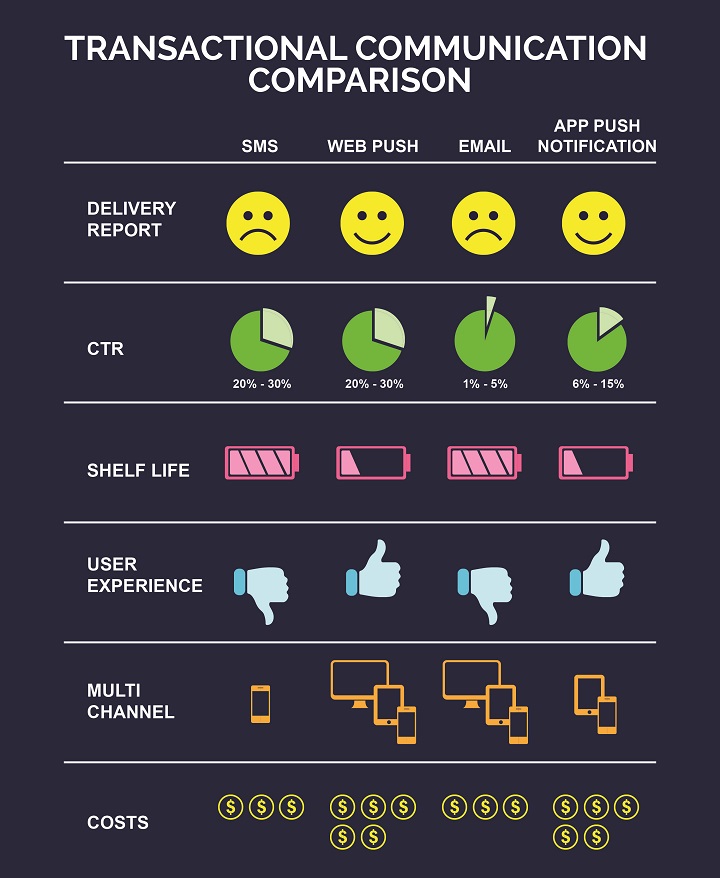
The channels have their own ups and downs. SMS is pesky, space consuming and irritating. Let’s be honest here, it’s old. If you want to make your mark in the present, then you need to move along (or ahead, as a matter of fact) to rise to your true potential. Almost everyone sends emails these days and it has become so ‘yesterday’. It’s time to pack your bags and move ahead of email. As far as web push and app push notification are concerned, there is no way that you can retrieve old notifications. Once you dismiss a message, it is gone forever.
All said and done, each channel plays a role to notify users. It up to you to fish out the advantages and choose which channel works best for you. Maybe you could get the best of some channels.
For example, you could send out major updates as emails and send constant updates as a web push message. You could mix and match, experiment and see what gives you better response, but keep an eye on your pocket as well.
91% of dissatisfied customers will not do business with you again. Therefore, transactional communication should take place with utmost caution.
The whole point of terrific communication is informing users before they even have time to ponder about it (more like a reflex action). When communication is seamless, giving users disruptive information, the user leaves happy. And we all know how happy customers can be good for you. Choosing the right mode of communication would make all the difference.
I don’t know about other channels, but if you want to try out web push notifications, we are right here 🙂 Log on to www.izooto.com to start pushing out notifications for free!

Pravya is a Product Marketer at iZooto. In love with animals more than humans, obsessed with amazing hair and educating the world about digital marketing. She secretly is mastering the art of stone balancing. Amidst all of this, she also squeezes out time to paint on canvas. Her dream is to go on a bike trip to the highest motorable road. She writes often on the iZooto blog.
Twitter handle – @pavipravin
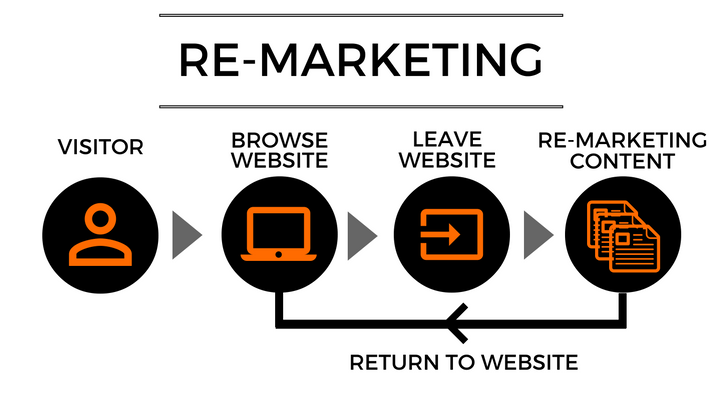
Save more abandoned shopping carts this year by developing a full cycle re-marketing system. Segment your shoppers into their respective groups based on their actions (or non-actions) and present each group with relevant messages that urges them to complete their transactions.
Have you ever visited an online store and then for weeks after seen that brand appear on your social media feeds and all across your regular news and shopping sites? That’s re-targeting at work. It’s part of a full re-marketing strategy.
eCommerce presents the opportunity to offer a uniquely personalized experience to shoppers and is what sets us apart from brick and mortar stores. Test different tactics with each group and find what works best. New users who abandon their carts are likely to respond to promotions like first-time purchase discounts.
There are also those that visit your store multiple times and check out several different products, without making a purchase. You’ll want to monitor such activity and have separate campaigns with different messages for each of these user segments.
You also have the option of setting up automated re-marketing via services like Retai.ly which takes care of all the re-targting advertisements and helps you close sales from dropped users.
Think of your social network pages as a person, rather than online applications. Behave as though it is an actual human by interacting with people, making friends, and as with the offline world, don’t be afraid to make (a few) mistakes.
Share your joys and hopes and apologize for your shortcomings when they do occur.
Pick one social platform that you want. They each have their particular area of expertise with which to increase your skills.
Master Facebook

For example if you want to try social ads, Facebook is where its at. You can build very robust campaigns and bolster your marketing prowess through Facebook advertising.
Facebook has a tonne of options besides paid advertising. Join groups and engage with the communities, or create your own. Have you created events on Facebook before?
In fact, if you choose to be a master of Facebook, you’ll certainly have to take some time off your regular schedule to explore every nook and cranny on the platform. That way you’ll have a working idea of what sort of options you have available.
Jon Loomer has without question the top resources for mastering Facebook. If you’re looking to master Facebook marketing, go learn from the best.
Master Instagram

Instagram is great for those who are visually adept to showcase aesthetically pleasing visuals. However, even if you are design impaired (like myself…), it’s a very forgiving platform to improve your eye for design. The platform comes with a myriad of filters and tools to help you craft appealing images.
You can take your work to even greater heights with the help of third party online image editing software like Canva and Piktochart, which enable even untrained amateur designers to make stunning images that IG champions will appreciate.
Master Twitter

If you are a wordsmith then you will find Twitter to be your cup of tea. Twitter is all about honing your copy writing skills in 140 characters.
You can pair each post with images as well to tell an even more compelling story, but the real challenge is being able to craft the perfect message with just those limited characters.
That said, Twitter is no one trick pony platform. For example, you should create your own category lists like “Influencers”, “Ambassadors” or “Collaborators” and add relevant people to them. These lists can then be used for anything from content curation to content promotion, or any other creative ideas you might conceive.
Master YouTube

This is the platform for you if video content is your thing. It really doesn’t take a lot of learning before you have your first video up.
Video is where the bulk of audience engagement lies these days and YouTube is the place people go to search for videos.
Product videos do very well when placed on your product pages, and it also helps drive traffic to your page since people searching for product videos on Youtube (and other video platforms) will be able to follow links back to your site.
During the typical customer journey, people will search for reviews and tutorials of the products they are shopping for, so concentrate your efforts on those types for your product pages. However, don’t let that stop you from creating less promotional and more artistic videos to share with your audience, especially if they are relevant to your business.
Should this be your chosen mastery it will prove worthwhile in the long run as mastering it means by the time you have several dozen videos created, you will likely also have learnt as many new video editing and directing techniques.
All that on top of the numerous ways to promote your content and engage with your audience.
Whether it’s a back-end software to make your life easier (and grow your business), or a front-end app for your customers benefit, pick one and get it working at its fullest potential.
This can be anything from:
These technologies can be implemented with minimal effort (and minimal results), but to reap entirely the rewards of your investment, you should take the time to grasp how it works, learn the best practices and test it out yourself.
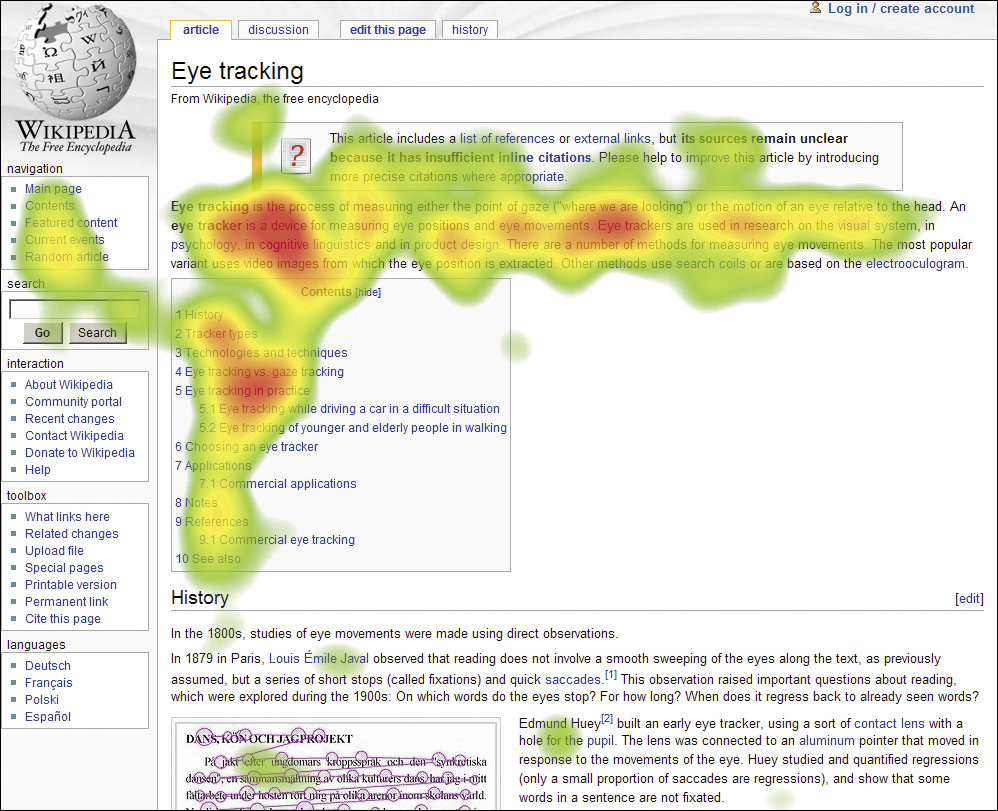
For example, implementing an analytics suite for your eCommerce store may seem like it requires comprehensive technical knowledge, but highly visual Drag’N’Drop software such as Mixpanel make the tasks achievable for even those with minimal tech savvy. At the end of the day you’ll have a ton of data shwoing how shoppers experience your site and which areas you should take steps to optimize.
Flash sale modules don’t even require much back end implementation, but learning best practices and how to implement them so both you and your shoppers enjoy the maximum benefit requires time and experimentation.
Learning to track and analyze link clicks will help you optimize your social media performance by showing you which posts get the most clicks. Eventually you will graduate to site wide tagging with a tag manager(the sort used by big league eCommerce players), but you’ll surely have someone or a team to implement it properly.
If you plan on only one undertaking throughout 2017 OR if the idea of expressing yourself by educating/entertaining people interests you, this should be it. Your blog content can be in any form, from a traditional written blog, to videos, image galleries, or even podcasts if can manage it.
Blogging is part of the content calendar, but I like to plan it separate from other content since I’ve done enough of both to know how to integrate the two efficiently.

For example I always leave space in my social media post schedule for when I know I’ll be publishing blog content so I can promote that instead. Sometimes I decide that the promotion of blog content will not be part of normally scheduled social posts but will be in addition to it.
The thing about blogging is that I spend most of my time promoting the content than creating it, so it reaches as many people as possible, thus driving more traffic to the site. So when I suggest blog regularly, I don’t mean to endlessly create content.
Rather, the entire cycle of blogging starts from research, moves to creation, then to publishing it. But it doesn’t end there, as this is when you begin relentlessly promoting it.
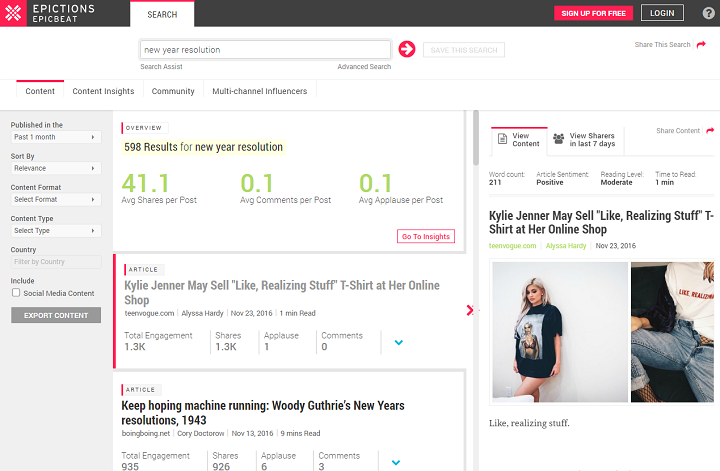
I use services like Epicbeat and Buzzsumo for finding types of content that people share a lot so I can figure out what I will create, as well as finding influencers I can reach out to on social media when I’m ready to promote to people who would find my content worth sharing.
Keep in mind that although blogging and regular content updates have a significant impact on your search engine rankings, blogging for SEO is a long term goal that requires commitment and consistency to see results. Don’t jump in expecting to deliver an immediate surge of traffic to your site through blogging alone.
Have a look at other popular blogs both within and outside your niche. Besides giving you ideas about content and styles, it will keep you motivated and inspired to continue throughout the year.
Companies that leverage social events like valentines, children’s/father’s/mother’s day, school holidays, and Halloween have the advantage of staying in topical conversations.
I usually see F&B companies take the lead with topical promotions, but anyone can get in on it, even eCommerce merchants. February 5th is Super Bowl Sunday, consider creating a promotion that takes advantage of the amount of exposure the event receives, with a football theme or offering promotions related to the game.
Earth Day on April 22nd is when you could show your support for our collective home by donating a percentage of profits to earth-friendly causes, and remind your readers that by shopping online they are also helping to reduce their carbon footprint.
By planning and consistently running specific promotions centered around such events, you are building brand awareness by being in hot conversations. Planned correctly, you should also see increased seasonal spending with your brand.
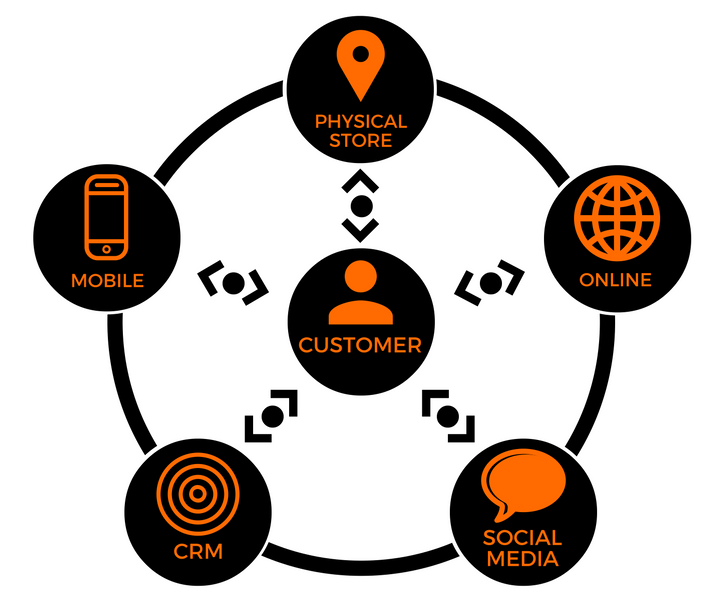
Take the time to grow your brand on previously untouched channels. If you’ve never sold on Amazon before, now is the time to think about being a merchant on their platform. Or if you’re in the arts and crafts market you could do well on Etsy.
When the time is right you will even want to take your business to the physical dimension, but for now, just make sure your brand is visible everywhere on the internet.
You should be being willing to sell anywhere and everywhere that there are customers willing to pay you for your products. The other benefit of having multiple sales channels is that you won’t be left in the lurch if it fails for any reason.
Next time you tend to non hush-hush business operations, consider documenting or even live streaming it as an event.

In the past I worked at an IT hardware distribution company. Every time we got a new shipment of products in, it was cause for celebration because our target market would get really excited about new arrivals and updated stocks, especially if they had been waiting for new supplies.
Our CEO would take photos of the delightful new goods and post it on our media pages himself because it was so effortless to engage in such an rewarding manner with our audience. It wasn’t a time where live streaming such events would have been a priority enough to go through the hassle of setting it up the tech for it, so photos sufficed.
Now, technology has advanced to the point where all you need is your phone and you can live stream events that your audiences will enjoy: a behind the scenes look at what goes on with your business.
This sort of content gives life to your organization. The human touch will help you seamlessly engage with the public you want to reach because sharing your routines gives your audience a glimpse into the actual human beings behind the products and services you offer.
Every product makes a promise to the buyer: to change their life for the better. Before buying, however, people want to see how -and in what context- a product is used. If you choose to improve your product image aesthetics, then start by adding lifestyle images to your product pages.
Lifestyle product images sell a customer on a piece by helping them visualize it in context since they display your product features in real-time. The common white backdrop product image won’t tell a story.
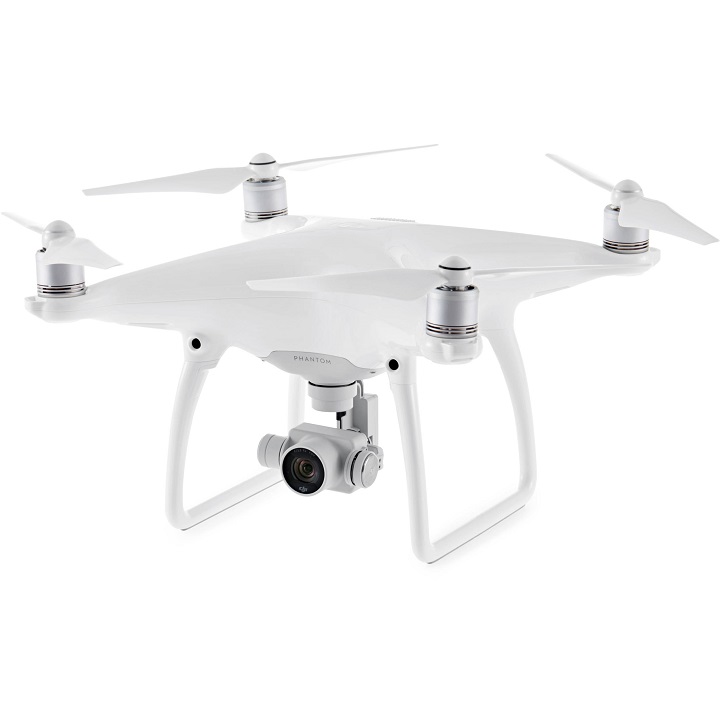
The DJI Phantom 4 is shown clearly against the typical white backdrop. It’s a good quality image but without context it lacks the ability to evoke emotion, or convey any meaningful information.

In this case the Phantom 4 is displayed with context! Looking at the image you can clearly see the size of it, which I couldn’t from looking at just the first image.
Imagine if this were a thermostat or desk and all you had was the first shot. You make the purchase but when it arrives it might not fit in your space. Having a lifestyle image would have given you the information you needed to decide perhaps it would be better suited elsewhere.
This is information you can help customers to glean from product images. After all, eCommerce merchants need to make up for the lack of tactile fulfillment that physical retailers can offer.

When you want to take it to a whole new level, these sort of lifestyle images -ones with the product in action- have the ability to inspire emotion and imagination in customers. Someone viewing it will start fantasizing about possibilities and envisioning scenarios of how they would use it if they had it themselves. Powerful indeed.
Have a look around J!NX store. They do a fine job of:
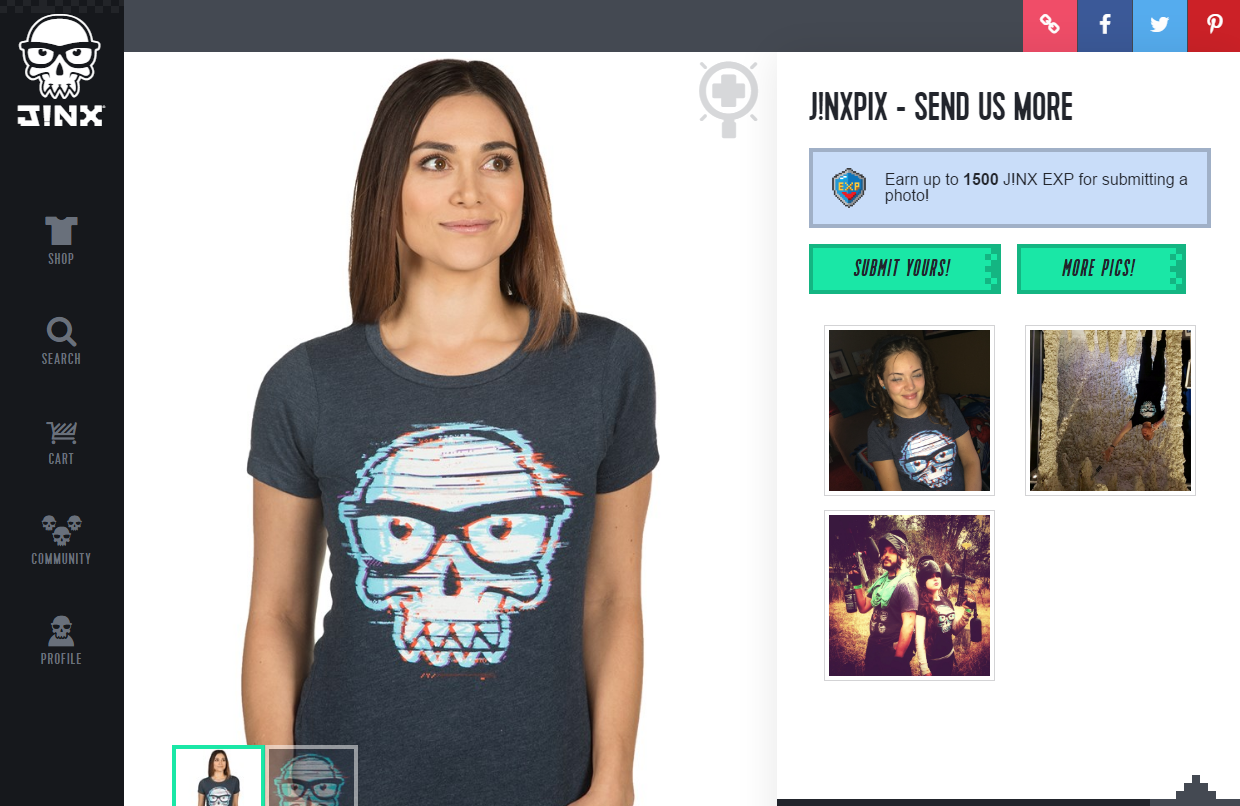
If you’ve an abundance of energy, produce and add several lifestyle images, then go a step further and devise a plan to get your customers on board by hosting pictures of them with their purchases. You can entice customers to participate by gamifying the process or rewarding them for each post they make, but really, gamification is an entire topic of its own.
If you enjoy planning and keeping activities organised, there’s a good chance you already have a content schedule in place. If not, this could be your time to start, at least for keeping your social media organized.
I limit each period(month or quarter) to a maximum of two general themes. For example if running a baby/motherhood website, I’d focus on mothers as well as families during the month of May (women’s day), and dedicate November for content focused on children (children’s day).
As with a blogging content calendar, be topical but also try to stay relevant to your industry.
I use a simple Google spreadsheet to plan and keep track of everything, but you can use Excel if you prefer. Personally I hardly do anything on local (being a digital marketer and all) so I use Google Sheets. I find it sufficient for these sort of tasks since it’s live, shareable instantly, and I can link between documents, sheets and presentations easily.
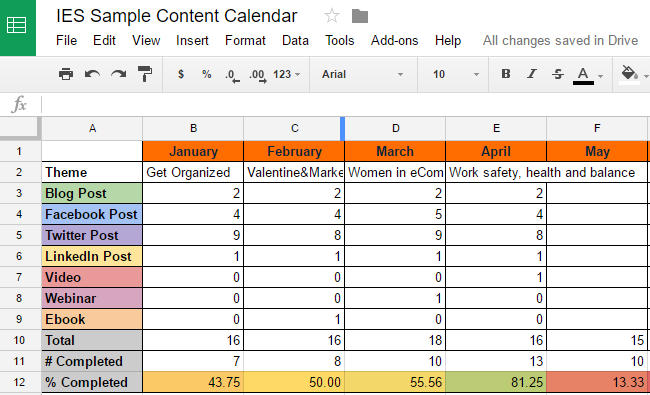
This is our yearly outline sheet. In it I include periodic themes and schedule the minimum amount of content to be produced. Since this is a new year resolution post, you may find it helpful and motivating to see your progress. To that end I’ve included two rows that show completion rates for each month as well as a yearly summary.
Add whichever channels you produce content for and determine your posting schedule. If you’ve no idea how much you can take on, don’t worry. Start small and do what you can. If you are already pressed for time there’s no point planning for 10 posts a day if you’re not able to execute it.
Instagram and Pinterest are not strong channels for us so eventhough InstanteStore does have official accounts on those platforms, I don’t plan for content promotion on those channels. I prioritize tasks to leverage where our strengths lie, and you should too. So if you find IG effective to reach your audience compared to Twitter then prioritize that and add it to your plan instead.
Things like videos take more time and effort to make, so I schedule it more conservatively, perhaps once a quarter or even a year. A webinar could double as the video content so I schedule it for before the video content.
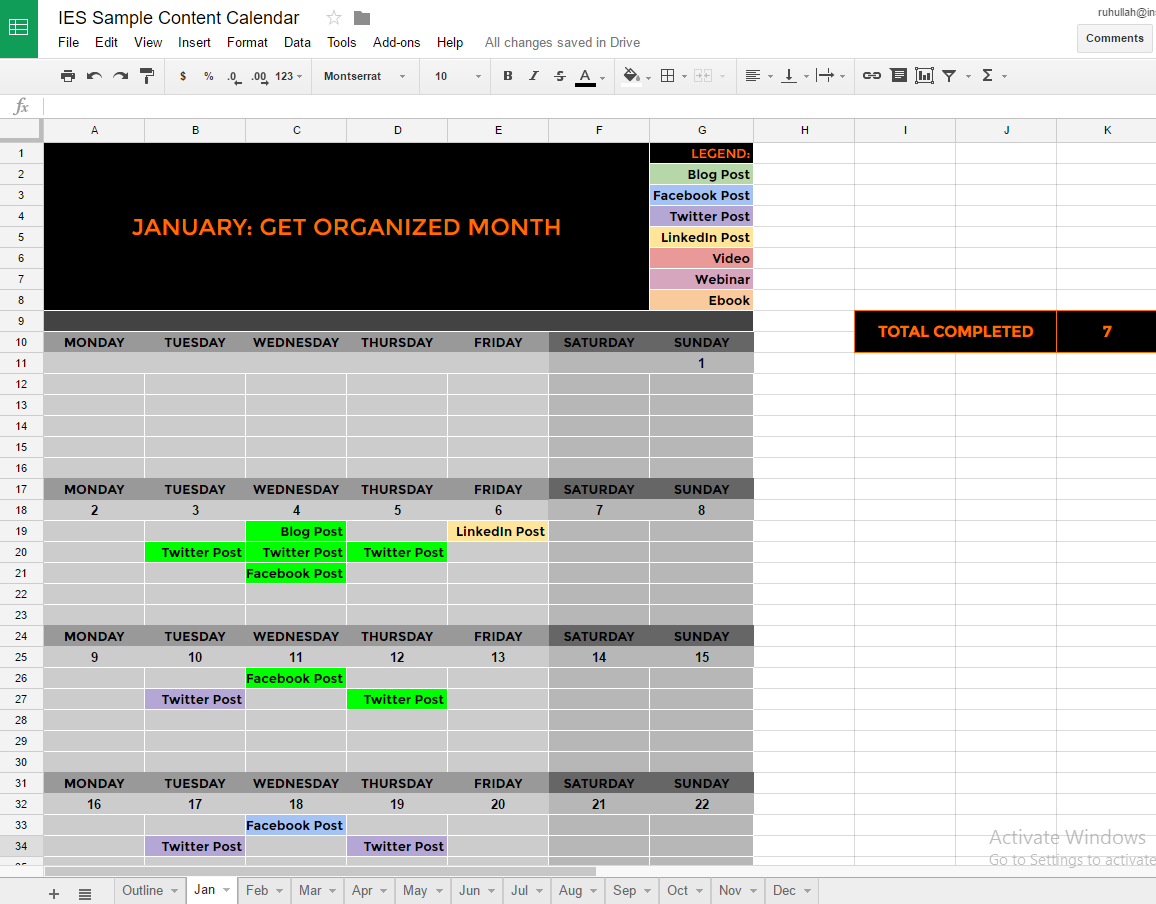
On the following sheets are the monthly views that go into detail about the daily activity for each month, with auto-updated counts for total of posts per month. Remember I said I can easily link between documents? This is where I do just that.
It’s an immense quality of life perk that each item on the monthly view is linked to the my content creation slides (I just happen to use slides) for easy reference, and it takes me to a page like this one:
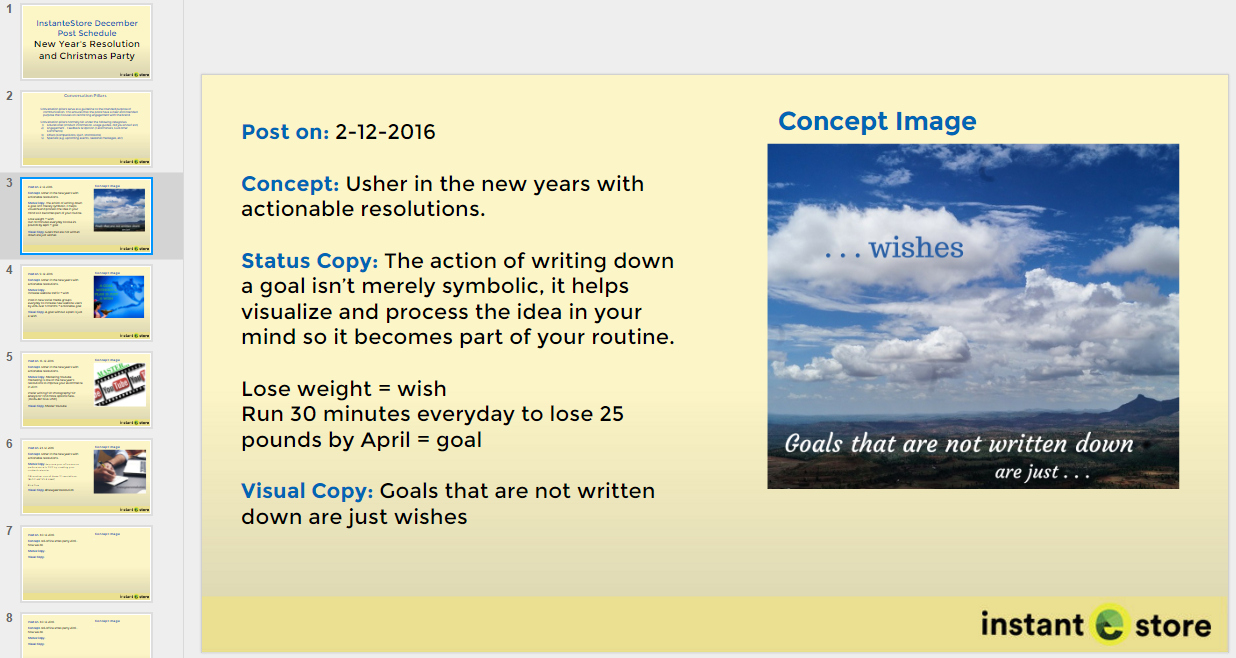
This is the crafting bench, so to speak. I use Google Slides as a canvas to draft concepts and the content copy, as well as come up with ideas for the post visuals. The image above shows the final result of a fully drafted post. In this case the posts are the pre-emptive messages before the actual blog post, which is the one you are reading right now.
With the entire year mapped out, it will free up the rest of your calendar for other priorities, or even leisure! You don’t have to create content for the entire year right away, but having a structured content plan in place will help you stay ahead of deadlines while keeping your mind clear and focused on your goals.
These are merely examples of how we plan our content calendar. You’ll discover your own methods and preferences and tailor your content schedule to suit your own style once you find your groove = )
Once again, thanks for reading our eCommerce blog. We hope you’ve found it valuable. We’re looking forward to becoming the top eCommerce blog of 2017 (and beyond)!
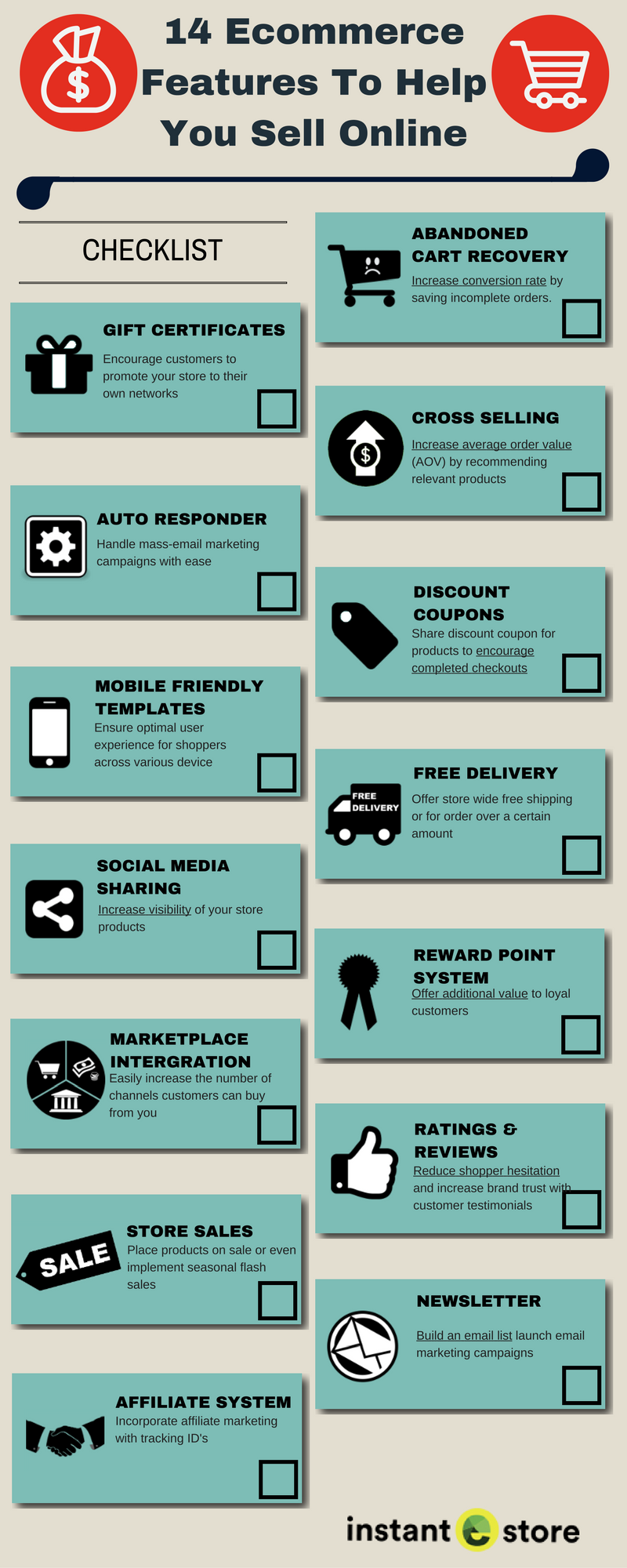
![14 Crucial eCommerce Features You Should Be Using [INFOGRAPHIC]](https://instantestore.com/blog/wp-content/uploads/2016/11/14ecomfeatsblogtitle2.png)
New merchants ask us all the time about choosing the right payment gateway to pair with their online eCommerce solutions, and the truth is there is no standard answer. We can usually help a merchant decide based on what their priorities are, such as cost, application time, or withdrawal time. So here is a eCommerce payment processing comparison to get you started.
Trust is a vital concept when it comes to social psychology in eCommerce. Trust appears wherever risk, uncertainty and dependency exists, and is something online shops strive to earn from their shoppers. Consumers trusting an online retailer is important in establishing transactional behavior.
It is a weighty concept that is often taken for granted because we believe we understand it, despite the range of definitions it carries. To consumers, doing business with an eCommerce merchant represents a step into the unknown thus creating positive trust-beliefs will help result in positive intentions (sales) from consumers.
According to findings in “The Science of Shopping Cart Abandonment” by Charles Nicholls: 74.6% of new shoppers will not return after abandoning a shopping cart, and so persuading shoppers to complete a purchase on their very first visit is of utmost importance for long-term survival, and why nurturing initial trust is so crucial in this step of the journey.
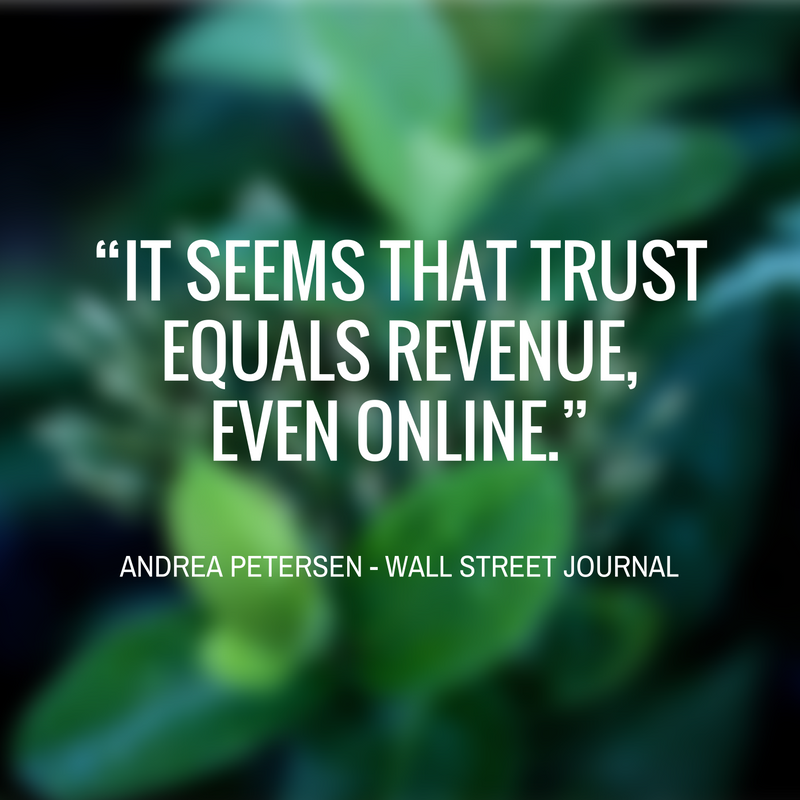
As Andrea Petersen stated in her Wall Street Journal piece:
“It seems that trust equals revenue, even online.”
Each party of an eCommerce transaction looks to eliminate risk and uncertainty by finding ways to increase trust. We acomplish this by building beliefs about the beneficial characteristics of the vendor. These characteristics can be applied to beliefs about the competence, benevolence, integrity and predictability of an online store.

1. Belief in competence is when a shopper believes that the merchant possesses the ability to deliver goods or services as promised, whether it is in terms of volume, delivery time, pricing or quality. Shoppers also want to know you are an expert who has the necessary skills to provide a convenient solution, and that you are dynamic– able to meet challenges that arise without excuses.
We see this come up a lot in the world of eCommerce. Belief in your competence leads to a positive action towards your business, and that trust carries so much weight that when broken it leads to anger, frustration and reputation damage within the online community. On the flipside, if that belief is reinforced by actual competence, the goodwill generated has the potential to spread like wildfire, leading to more belief and further positive actions.
2. Belief in benevolence is when a shopper believes the merchant is caring, morally conscious, responsive and is capable of goodwill towards him or her. A merchant that cultivates the belief of benevolence would not have the perception of taking advantage of the shopper by feeding their fears (eg. the fear of missing out), rather is one that acts in their best interest, that the service is not a scam, and is always willing to communicate matters with the client.
3. Belief in integrity is when shoppers trust that a merchant is honest, credible and reliable in their dealings by being truthful and upfront about things like pricing and delivery times rather than forgoing the truth in order to make sales. Merchants that demonstrate integrity accept the responsibility of the good-faith placed upon them and is the standard bearer of fulfilling promises and ethical obligations, like keeping client information secure.
4. Belief in predictability doesn’t actually have positive or negative values associated with it. It means that a shopper has the belief that your actions are consistent enough to the point that he/she can predict your behavior in a normal transactional situation, regardless of whether your actions are good or bad.
A customer may have high belief in the predictability of Amazon to fulfill delivery of an order within 5 days. A high level of belief in predictability would also forecast that a confirmation email and invoice will be sent immediately after purchase. Having belief in the predictability of an online merchant also means that the merchant’s readiness to handle a client’s needs will never alter over time.
These four beliefs complement each other and often one lead to another depending on the buying stage of a customer and what their current relationship is with your brand (fresh, has heard of you before or has conducted business with you before). The most important one is always the one that addresses the current fear of a customer and facilitates positive behaviors.
 If a customer fears being scammed, then their integrity belief is the most important. If the customer fears getting a bad deal like paying a higher markup price, then benevolence belief takes precedence. Fear that credit card details might be inadvertently stolen during the checkout process will rely on the competence belief that your technical ability to prevent such theft will address this issue.
Belief in these characteristics leads to trusting intentions, which is when a customer shows the intention of relying on the merchant despite being unable to control the merchants actions. The amount of belief a shopper has will affect their readiness to perform trust related internet behaviors compared to traditional shopping instances, since online shoppers have less control over their experience such as handing over sensitive personal information, or not being able to immediately determine the quality of a product or service.
These behaviors are actions like sharing sensitive information, adding products to cart or making a purchase by completing the checkout process, and are a natural consequence of their trust in or beliefs about the online store.
Rather than allowing customers to bumble haphazardly through the trust-intention-action process, there are of course things merchants can do to guide them through it to assure them that their beliefs are in safe hands and their intentions will have positive results.
A privacy policy lets your customers know that you are ethical when it comes to collecting their personal information (integrity). As such they are more likely to be open to sharing their personal information with you (intention). When a customer is more willing to share information then they are naturally more likely to act on it (behavior).
Not having a privacy policy in place on your online store can help you lose customers while being upfront about how you collect, store, and share personal data will allay the fear customers have about how their data is collected and used. They tend to be long walls of text filled with legalese that in a way discourage people from reading them.
Twitter has a very clear and well formatted privacy policy laid out which you can find here. Making it easily accessible for the average user shows transparency, which is a concept closely related to being trustworthy.
As the saying goes: those with nothing to hide hide nothing.
Trust seals & SSL certificates suggest that a site provides technical security for payment forms to prevent middleman interventions or network eavesdropping.
Koray Özpolat at the University of Rhode Island hypothesizes that the four factors surrounding the effectiveness of trusts seals are cart value, retailer’s sales volume, shopper experience and number of other trust seals displayed:
Cart Value
Trust seals are more effective towards the completion of higher value shopping carts.
The value of a shopping cart simply means how much the total value of the products in the cart amounts to. Higher value purchases are more risky and thus entail a higher level of risk-aversion thus providing information pertinent to security and privacy helps reduce perceived risk.
Retailer Size
Online retailers with a smaller sales volume benefit more from the presence of the trust seal than larger online retailers.
This is tied-in with an online store’s reputation. Someone who has never shopped on Amazon.com would have less concerns about the ability of the company to protect their information, becuase it is a well established marketplace that has served millions of customers worldwide. As such smaller eCommerce sites would be required to take even greater measures to address these concerns. Customers would naturally feel less comfortable shopping at your store if it is new or relatively unheard of.
Past Experience
The effect of trust seals diminish the more frequently a user shops at a particular online store.
It means that trust is being developed over time, and with the benefit of having completed successful transactions before, the need to be convinced of trustworthiness is gradually eliminated as the customer updates his or her perception of the merchant.
Varied Trust Seal
The impact of trust seals on completing the checkout process has diminishing returns as the number of displayed trust seals increases.
In other words, displaying all the trust seals you can get your hands on won’t do much to convince your customers to make a purchase past the first few unique or synergetic ones, such as a seal that addresses security together with seals the address identity and privacy. Having multiple seals that address the same concerns is pointless.
In terms of shopping cart abandonment, the research found that the optimal number of seals to display is only 2 and that there is a reverse effect (u-turn) on trust with an increasing number of seals. Hence it is crucial to avoid information overload when displaying trust seals as it may cause confusion or skepticism.
What’s interesting is a particular result from a study published by Christian Holst suggesting that the perception of security is more important to online shoppers than its actually technical security ability. The trust seals are often nothing more than certification of a site or company about its customer relations or business practices, whereas SSL seals are what suggest technical security on the site.

Image: Baymard Study
There are many places you might display your security certifications and credentials, on your front page, on a product page, or on the footer, but the most important location to build trust is at the checkout process, the page where a customer will enter their payment details. It is at this point that a person has the most alarm bells going off, so it is here that it becomes of utmost importance to build confidence in the ability to protect one’s privacy.
It should be standard practice by now for an online business to be engaging with customers, both individually and as an community. From a trust perspective, it also manages to convey that you are a merchant possessing the positive belief characteristics mentioned above, that it is benevolent, competent, honest and predictable. These positive traits solidify customers trust which lead to positive trust behaviors.
Interaction can occur through any channels your site has available, such as social media, email, phone, video calling, or even a support system on the site itself. It involves customer service, feedback, marketing and general socializing.
A great example of customer-facing eCommerce is Dell’s built-to-order model, which was once a thing Alienware did. With this model they were able to build stronger and deeper relationships with their customers.
This is interaction as well, since analyzing how your customers interact with your store (you) and understanding their shopping behavior and decisions can give you valuable data about how to better serve them. It can help you improve your design, user experience, content, and set pricing, which lead to increased shopping cart completion rates.
By building a good reputation a merchant is able to bring about purchasing behaviors. Improving reputation will also improve beliefs because reputation is the anecdotal evidence/rumour that the merchant has positive characteristics, while trusting beliefs are first-hand, and as stated above, lead to intentions.
The trend now is to prominently display customer testimonials as social proof about a good service rendered, and it is standard to have customer reviews on product pages, as these constitute a secondary reputation, that of the product you sell on your store.
Brand recognition happens naturally, but should also happen through your own efforts with marketing campaigns. Consumers are also more likely to trust merchants that actively advertise their marketplace as it shows an investment in growth. It is unlikely that shoppers want to have business dealings with companies they think are in it for the short-term, as this will hamper an important part of transactions, which is after sales support.
Links to a reputable site can provide the extra push to assure customers that you run a reputable site. Quality outbound links suggests that you run a good company because you are good company, by way of transference.
The initial trust a shopper has for an unknown store will be more strongly influenced by a better known domain when there is a connection (hyperlink) between the two. This transference of trust can be achieved in many ways, not just by linking to other domains, but also by connections to influential individuals within online communities such on social networking sites and forums.
On online marketing forums such as the Warrior Forum, vendors and affiliates gain reputation by being active in the hyper-niche communities found within, creating trust and favourable reputations, allowing each other to cross promote their services, confident in the knowledge that each other are in high reputation standing among the public. After all, nobody wants to affiliated with shady dealers or those with a poor reputation – whether by perception or concrete.
Reputation is also strengthened when there is a link between your online store and a physical location, which we cover in the next item.
Having a proper channel to receive inquiries and complaints goes a long way in creating trust. It shows your users that there is a real person running things, and that you are available to be contacted should the need arise.
Some businesses choose not to disclose any contact details whatsoever, instead having a contact form to direct queries. Whether this might be a good practice for your business is something only you can determine by understanding your customer base. Others businesses are fully transparent, and it seems to work for them.
The amount of information you are willing to share is totally up to you, however a Contact page should be the bare minimum, then adding social media links, email and then live chat support as the need arises. You may also want to add business hours and your address if it is applicable.
Being active in updating the content of your store instils a sense of comfort whereby a customer knows that he/she is not in a deadzone. Fear of being in an abandoned site will obviously lead to phenomenal bounce rates. Updating your inventory or updating the product information helps your store stay fresh and alive.
Consider creating a content strategy for your products by mapping out time-periods for content updates. Several merchants I work with now choose to have a content cycle for individual products, which means not uploading all the content right away, but doing it over a period of time. For example uploading the product and details right away, then in week 2 adding a long-form product description or even a dedicated blog post about it, and in the third or fourth week uploading a video of the product as either a review, a tutorial, or the now very popular unboxing video format.
Even if your store features products with slow development cycles, you can work around this by generating blog content and being active on social networks about your regular operations or by events, expos or roadshows you attend. These updates also have the benefit of conveying to your customer that you are a creator and community participant, not solely a profit maker- or: Benevolent.

The social psychology of trust in eCommerce is about putting yourself in your customer’s seat, figuring out where your customers will have gaps in trust, then patching those gaps up. Empathizing with your consumers and their trust needs requires taking action on providing information to ease them into a trustworthy relationship with you.
As you can see, understanding the fears and pain points of your eCommerce users is paramount in increasing conversions. Trust exists differently for different people at different stages of their buying journey.The tactics mentioned above will alleviate common fears most customers have when encountering a new online shopping store. They work in tandem by gradually reducing risk-aversion and increasing belief in not getting ripped off.
The Bottom Line:
Shoppers need to trust you to provide them with a reliable, safe and convenient service before they will ever conduct online business with you.
If you found this post useful, please consider sharing our eCommerce blog with those who will also benefit from it. Do also comment with your thoughts/examples/horror tales below, or if you want a more private conversation you can reach me via Email. Thanks!

InstanteStore is proud to be part of Project Merdeka this year as our nation celebrates it’s 59th birthday.
Project Merdeka is a collection of deals offered by local Malaysian startups to celebrate Merdeka which is Malaysia’s Independence Day or Hari Kebangsaan.